
From a keyword list to a stream of SEO articles in WordPress
AI Marketing Engine turns scattered keywords into a working SEO pipeline: a semantic core, site architecture, a content plan, articles in WordPress, and ongoing reinforcement of published content.
The core scenario: "give us keywords — get a content system"
An ordinary AI generator writes a single article. KendaliCRM builds the entire framework: which topics the site needs, which pages should be Money Pages, which articles support sales, how to connect them, when to publish, what to send to WordPress, and how to reinforce already-published material afterward.
Keywords become clusters, topics, and long-tail queries.
Content is tied to offers, entities, and Money Pages.
The system lays out publications into a manageable calendar.
WordPress receives drafts with an SEO structure and internal linking.
Five connected modules instead of chaotic article generation
AI Marketing Engine is built as a sequential process. Each step uses the result of the previous one: the core becomes architecture, architecture becomes a plan, the plan becomes articles, and articles become assets for measurable reinforcement.
AI Semantic Core
Keyword import, AI clustering, high/mid/low-frequency logic, and additional generation of low-frequency long-tail queries.
AI Site Architecture
Money Page, supporting pages, an entity map, and a graph of internal linking around the offer.
AI Content Planner
A 2–3 month content calendar with publishing-frequency limits and business priority.
AI SEO Publisher
Generation of SEO articles, FAQ, tags, and internal links, plus sending drafts to WordPress.
Connectivity
Each module feeds the result of the previous one: keywords → clusters → structure → plan → drafts. No gaps between stages.
Content Evolution
The fifth step audits a published article against competitors, computes a Coverage Score, finds gaps, and reinforces it without changing the URL.
Author control
AI proposes the strategy, but final publications pass through an approval gate. The author stays the editor.
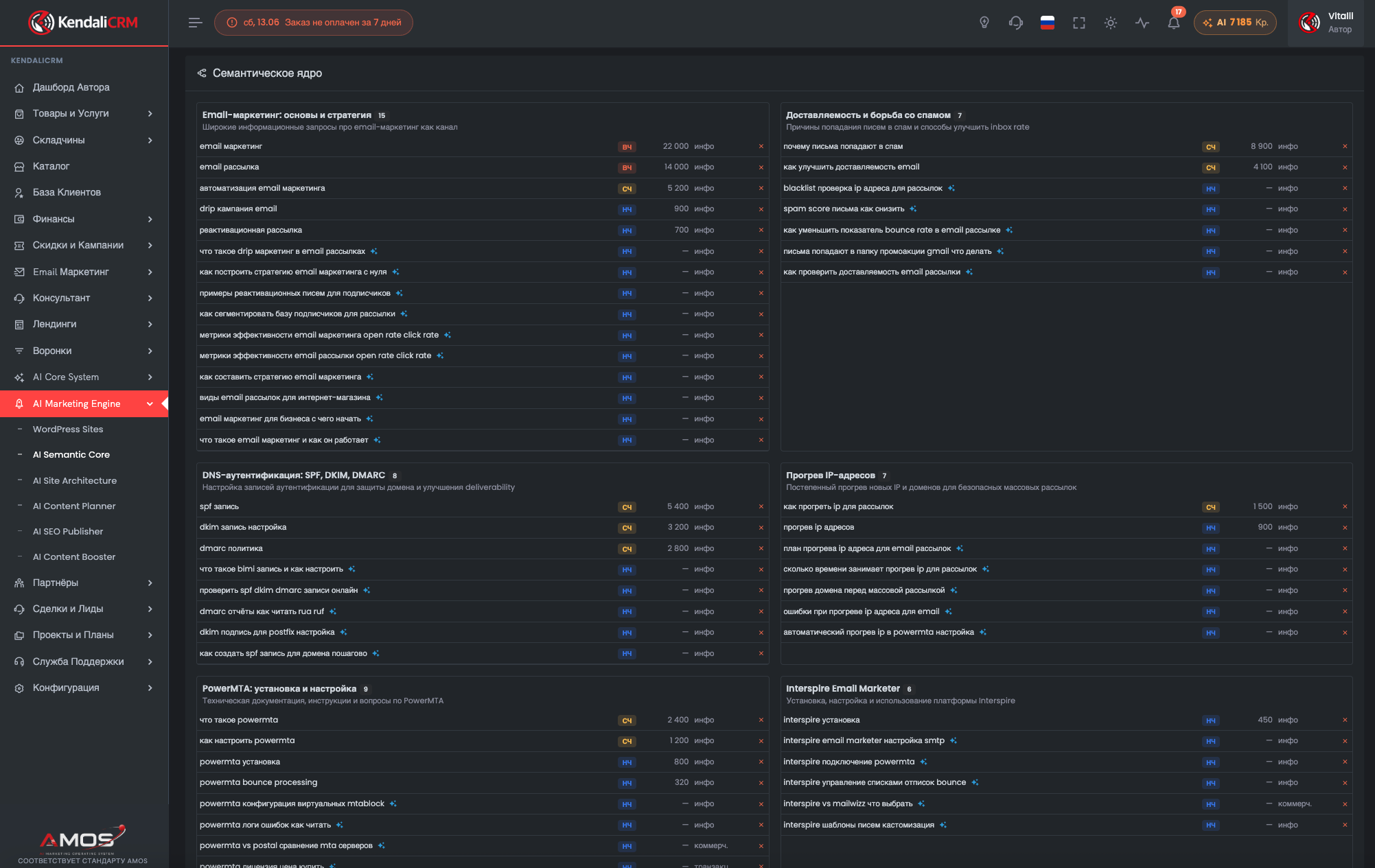
A semantic core without manual chaos
The first module takes a raw keyword list and turns it into a structured topic map: it groups queries, separates high-, mid-, and low-frequency directions, and then expands the core with additional long-tail queries.
From a keyword list to a working topic map
- import keywords from TXT or CSV;
- clustering by meaning and search intent;
- tagging by frequency: high / mid / low;
- additive expansion of the core without losing structure;
- preparing the foundation for site architecture and the content plan.
keywords.csv
  → AI clustering by intent
  → tagging high / mid / low frequency
  → generating low-frequency long-tail queries
  → semantic core
  → input for Site Architecture
Site architecture is built around sales, not random topics
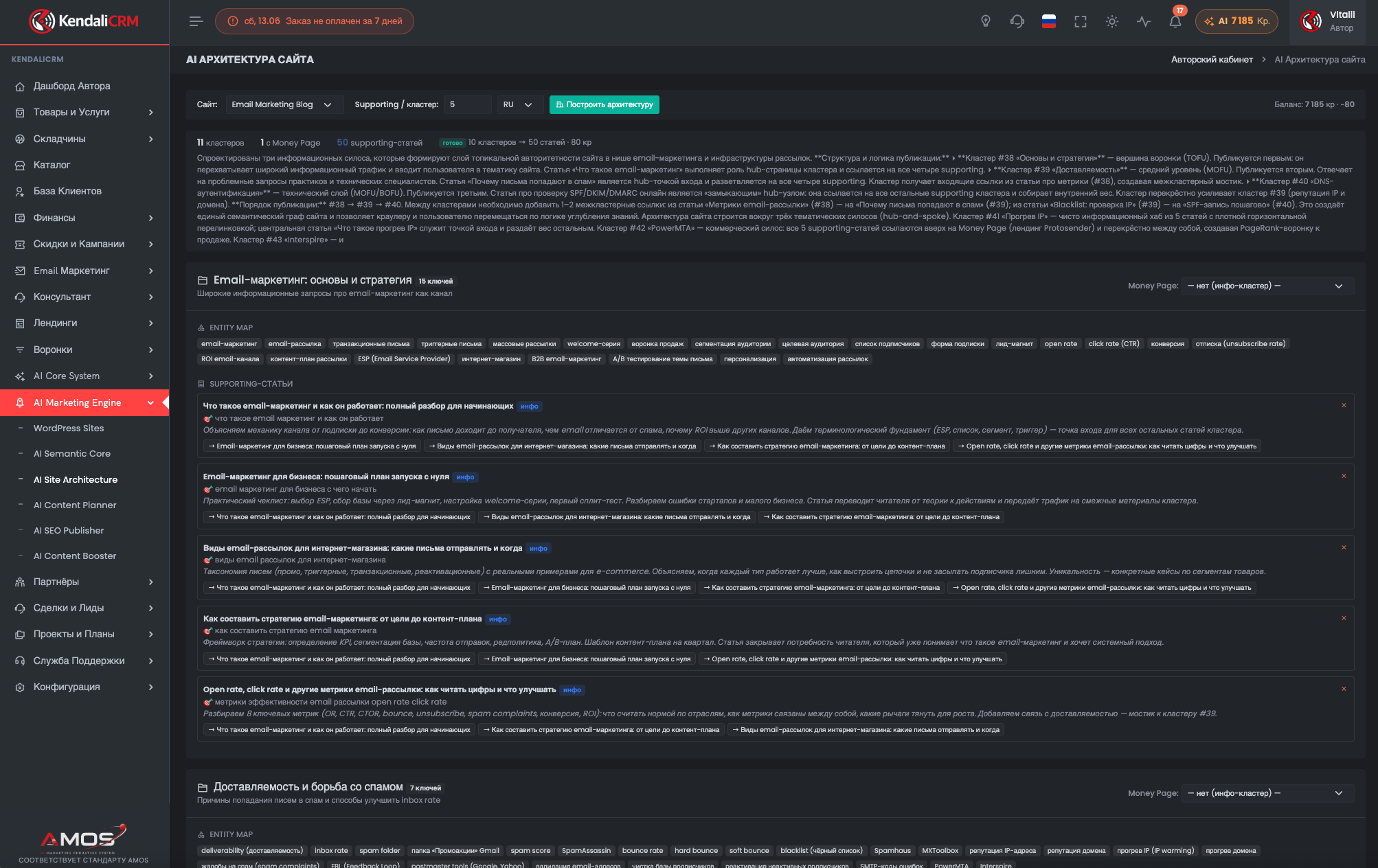
The second module turns semantics into an SEO structure: it determines which pages lead to a sale, which articles support the main topics, which entities to cover, and how to connect the materials into a thematic silo.
Money Page
The main sales page or offer landing where commercial traffic should arrive.
Supporting pages
Articles that address informational queries and reinforce the main sales page.
Entities and internal linking
Key entities are covered, while a graph of internal links connects articles into a thematic silo.
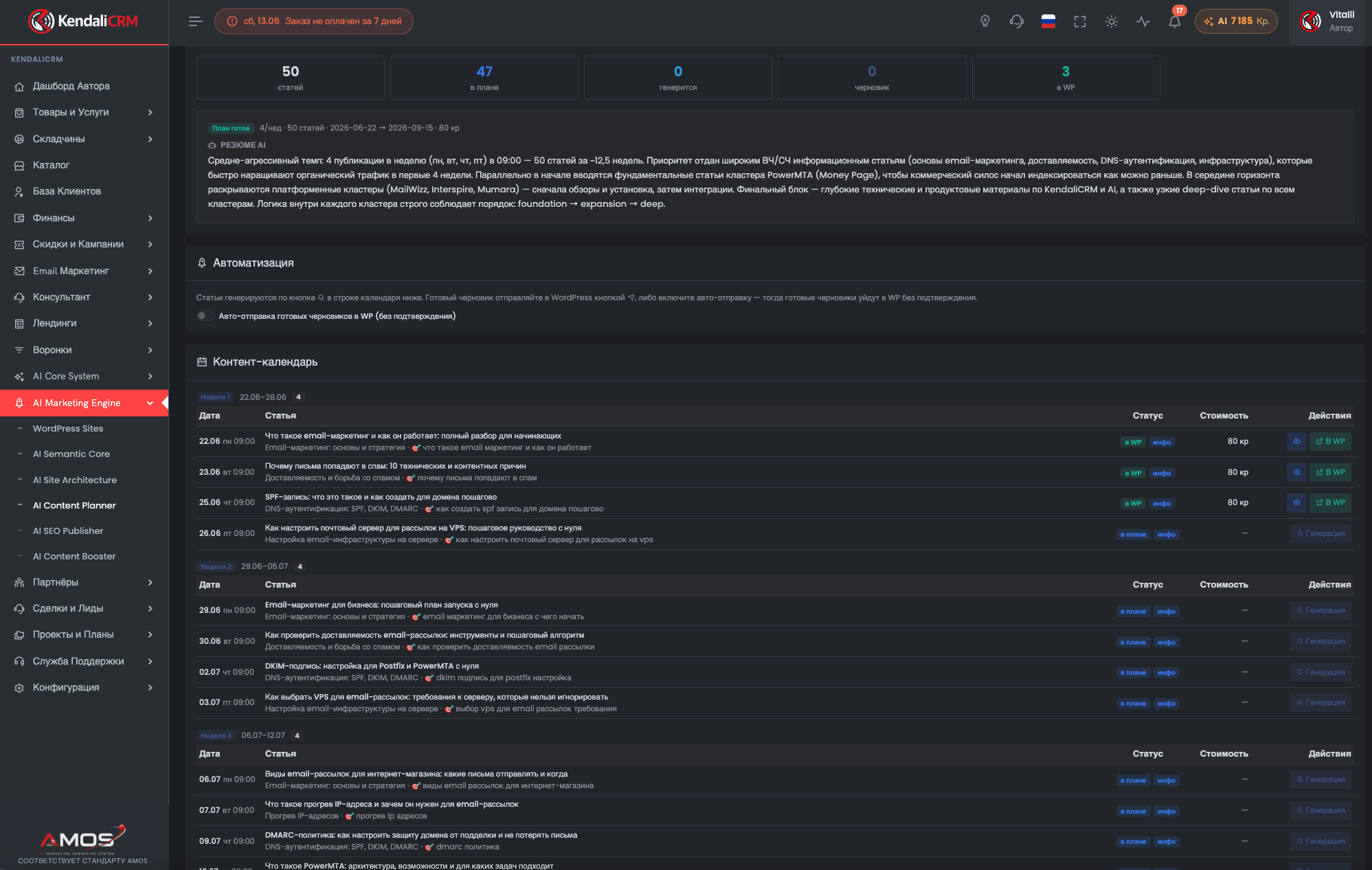
The publishing plan is built around your business goal
A content plan is not a list of topics "for someday." It accounts for site architecture, business priorities, an acceptable publishing frequency, and article order so that content grows systematically.
AI proposes the strategy, the system enforces the limits
- a publishing cadence for 2–3 months;
- limits like "no more than N articles per week";
- priorities: traffic, leads, or sales;
- a clear status for every topic in the working plan.
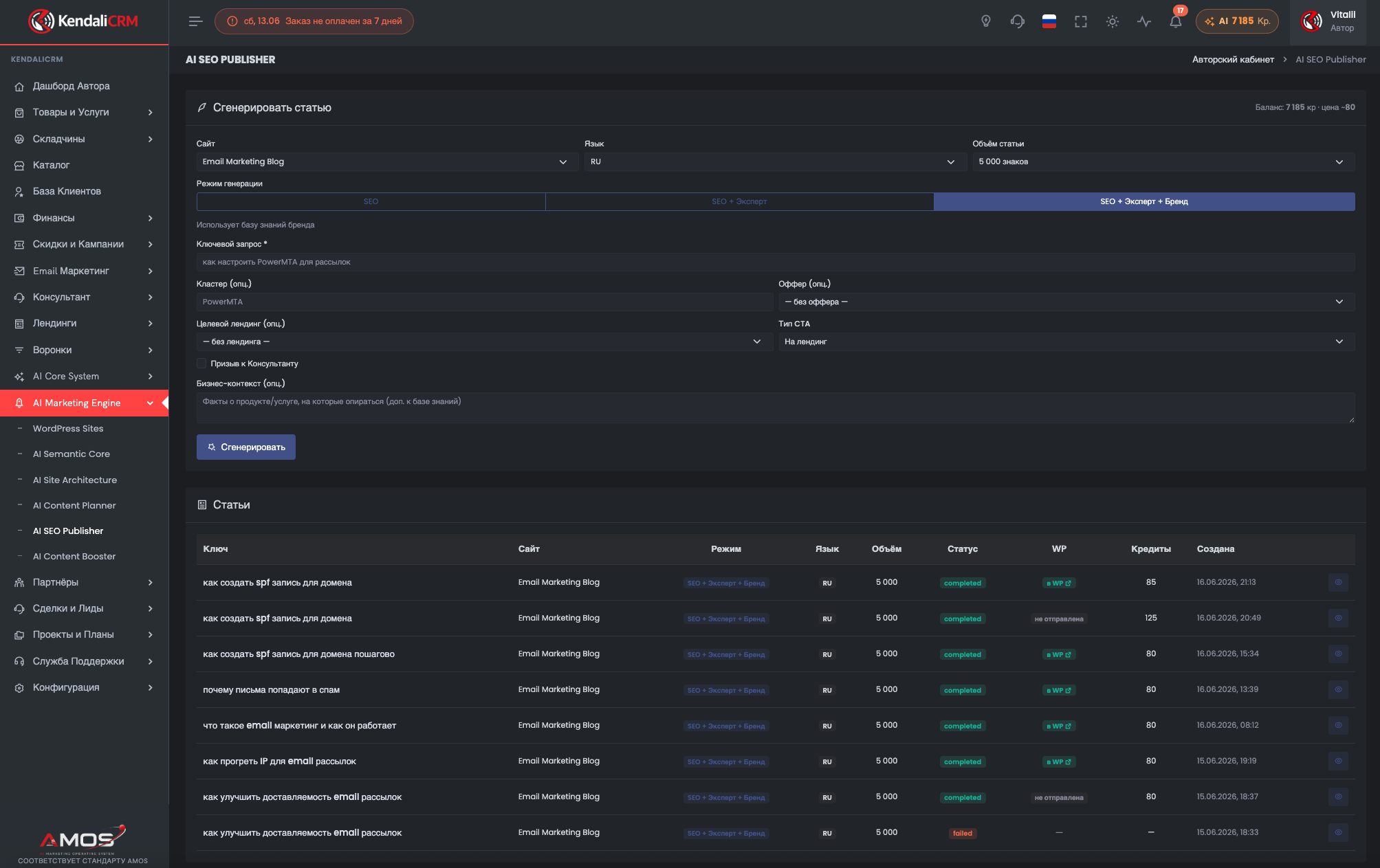
WordPress gets a ready SEO draft, not text from a chat
The Publisher takes a content-plan row, generates an article, adds FAQ, tags, and internal links, and sends the material to WordPress as a draft. The author stays the editor and controls publication.
Article selection
The author starts generation from the content plan or enables an agreed working mode.
SEO structure
The article is created with intent, headings, FAQ, tags, and a link to the site architecture.
WordPress draft
The material is sent to WordPress as a draft with a scheduled date and internal links.
Review gate
The author reviews, edits, and publishes without manually copying from an AI chat.
Content can be not only SEO-optimized but also brand-accurate
In AI Marketing Engine, what matters is not only generating volume but also accuracy. The modes let you reinforce an article with expertise and brand facts so the text doesn't read like sterile AI content.
SEO
Baseline optimization: focus on structure, intent, key topics, headings, FAQ, and article readability.
SEO + Expert
Expert reinforcement: more explanations, practical details, comparisons, and semantic completeness.
SEO + Expert + Brand
Brand facts: the system uses the author's knowledge base — numbers, case studies, product specifics, and unique facts.
A fact base instead of hallucinations
The author adds facts about the product, brand, case studies, and constraints. This data is used in Brand mode so the article is accurate rather than invented.
- numbers, case studies, and product specifics;
- constraints and unique brand facts;
- expert context instead of generic phrasing.
Your site connects as a working publishing framework
The site registry stores the WordPress connection, brand context, facts, and a page map. After synchronization, articles get real internal linking rather than abstract links.
- Application Password and connection check;
- sitemap and page-map synchronization;
- real internal links between materials.
Content doesn't get stale — it's measured and reinforced
Content Evolution analyzes a published article against competitors, finds gaps, computes a Coverage Score, and proposes reinforcement without changing the URL, intent, or brand.
Measurable article completeness relative to competitors
- Entity coverage — coverage of key entities;
- Subtopics depth — depth of subtopics;
- Search intent fit — match to search intent;
- FAQ completeness — completeness of the questions block;
- before-and-after measurements for a clear improvement.
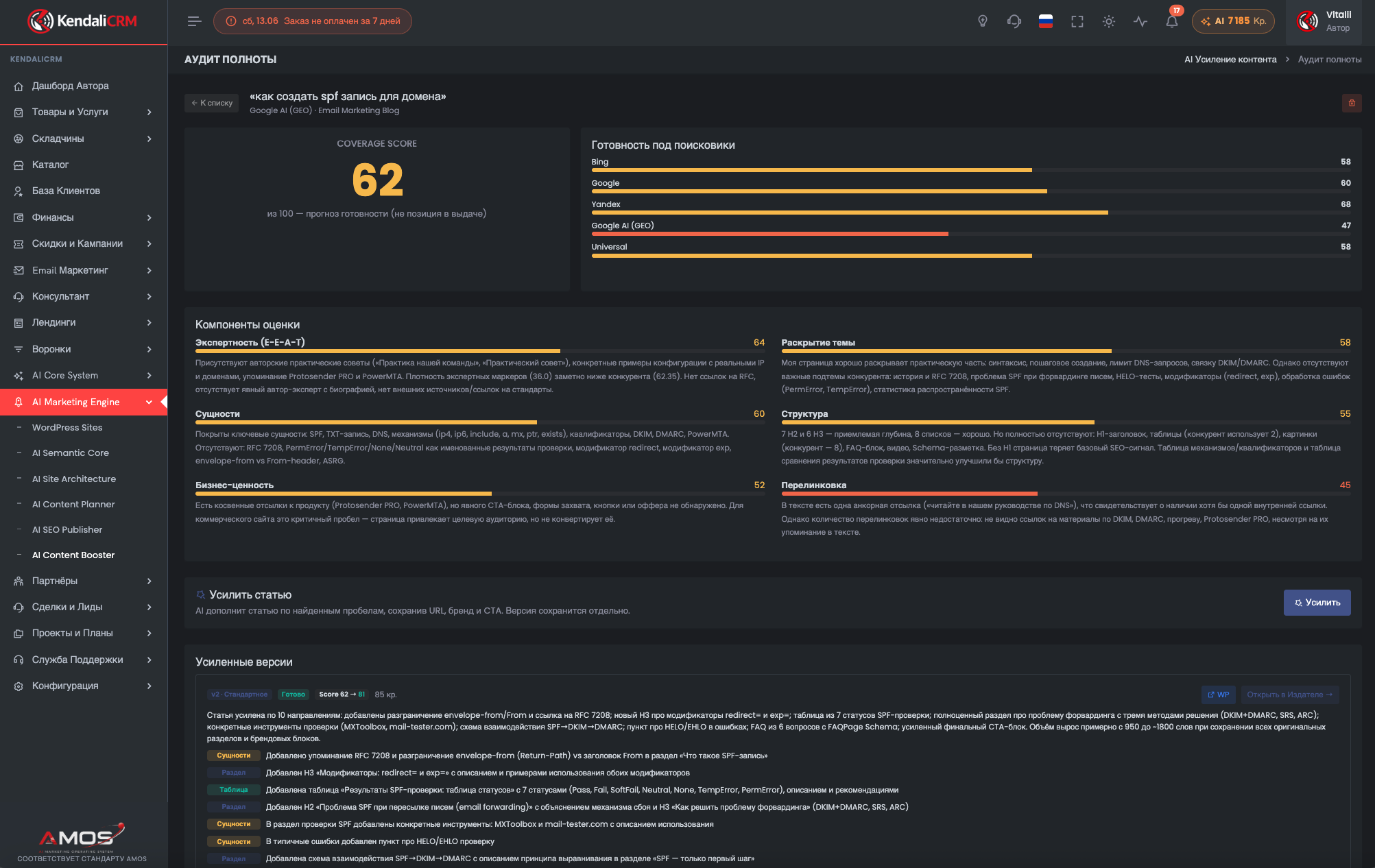
Gap analysis
The system shows which entities, subtopics, questions, and semantic blocks are missing from the current article.
Reinforcement without changing the URL
Content is improved on top of the existing page, keeping the address, intent, and brand style.
Versioning
Each reinforcement can be stored as a version with a clear quality gain and a measurable result.
AI Marketing Engine replaces a fragmented SEO stack with a single process
Semantics, structure, plan, generation, WordPress, and reinforcement work as one framework. This is especially important for product owners, agencies, SEO teams, and digital creators.
SEO content becomes a production line, not one-off prompts
You start with keywords, get architecture, plan publications, send articles to WordPress, and then reinforce published content by a measurable Coverage Score. This is AI marketing as an operating system.