
See not just traffic, but the money behind every click
KendaliCRM ties your landing page, offer, UTM, order, payment, and ad channel into a single data model. You understand which traffic brings leads, which landing page converts, where the payback is, and at which funnel stage money slips away.
In KendaliCRM, a landing page is more than just a page
Every landing page lives inside the attribution system. It knows which offers it promotes, how many visits it received, which UTM came in, how many orders and payments they generated, what EPC and ROI it produced, and how those numbers connect to the sales funnel. Instead of a pile of scattered pixels, spreadsheets, and external services, you get a single environment for decisions.
A built-in tracker captures visits, cookies, and UTM tags.
The order is linked to the landing page by token or visitor ID.
The system calculates conversions, EPC, and revenue by offer.
The funnel and channels show revenue, spend, and ROI.
External, Builder, and Internal landing pages in one panel
KendaliCRM supports external landing pages with a tracker snippet, internal pages, and builder pages. For each project you can set the URL, offers, publication status, and page type, and link it to sales.
External landing pages
If a page already lives on your domain or a separate site, just drop the tracker into the <head>. The system will start seeing visits, UTM, and sales without moving the page into another service.
Multi-offer logic
You can place up to 20 offers on a single landing page. For each offer the system creates its own payment token and then shows separate sales and conversion stats.
Live analytics
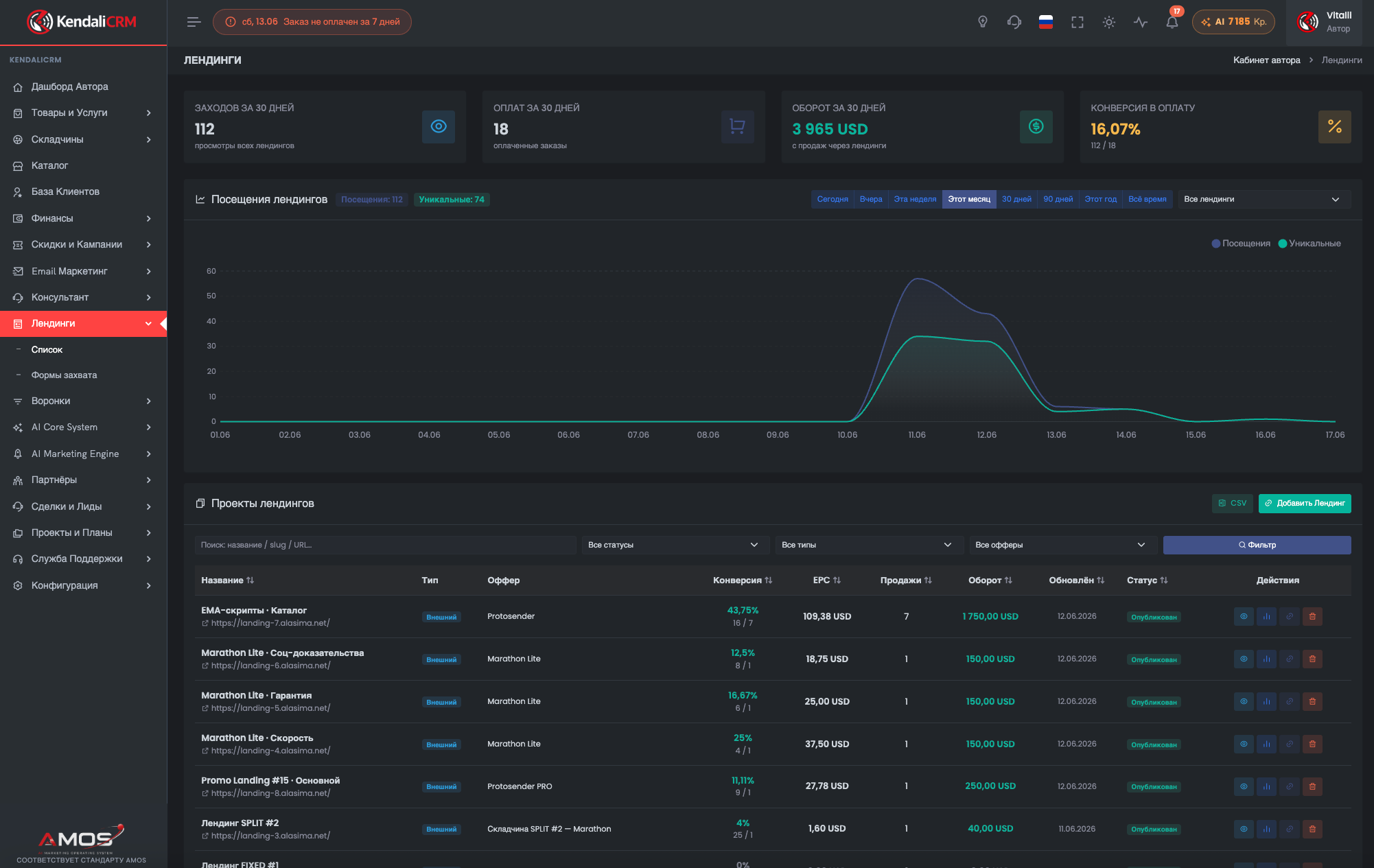
The landing page list instantly shows views, unique visitors, payments, conversion, EPC, revenue, type, status, and last-updated date. This makes it easy to see what works and what needs reworking.
A unified catalog of landing pages
- a list of all landing pages with filters, statuses, and CSV export;
- separate payment tokens for each offer on the page;
- a check of the installed tracker and a history of checks;
- lead capture via forms with anti-spam protection and contact dedup;
- a breakdown by period: today, week, 30/90 days, and all time;
- quick comparison of pages by EPC, conversion, and revenue.
Landing
  → tracker snippet + kt_uuid
  → offer A / offer B / offer C
  → UTM source / medium / campaign
  → order → payment → revenue
  → analytics by landing + offer + channel
The landing page catalog shows where the money is at a glance
The top block shows the trend of visits and unique visitors, while the table below shows the commercial metrics for each landing page project: sales, EPC, revenue, conversion, and publication status.
Two attribution models: hard and soft
KendaliCRM solves one of the biggest problems in marketing — losing the source of a sale. The system can link an order to a landing page and channel using two models, so you don't depend on a single pixel or external analytics.
Hard attribution
If the buyer clicked a link in the /buy/{slug}/{token} format, the sale is firmly tied to a specific "landing + offer" pair. This is the most precise scenario for buttons on a landing page.
Soft attribution
If the purchase happened later or through a different path, the system uses the visitor ID (kt_uuid) and visit history. This lets you reconstruct the first touch and the link to ad traffic.
UTM and first-touch
Source, medium, and campaign are saved in the visit event. From there, this data feeds into the breakdown by channels, landing pages, and revenue sources inside the funnel.
Click
A visitor lands on the page. The snippet creates a cookie and records a visit event.
UTM capture
source / medium / campaign are saved together with the URL, time, and visitor ID.
Checkout
The landing page button leads to checkout with an attribution token — the sale knows its landing origin.
End-to-end analytics
The payment flows into CRM, orders, finance, and the funnel, preserving the marketing source.
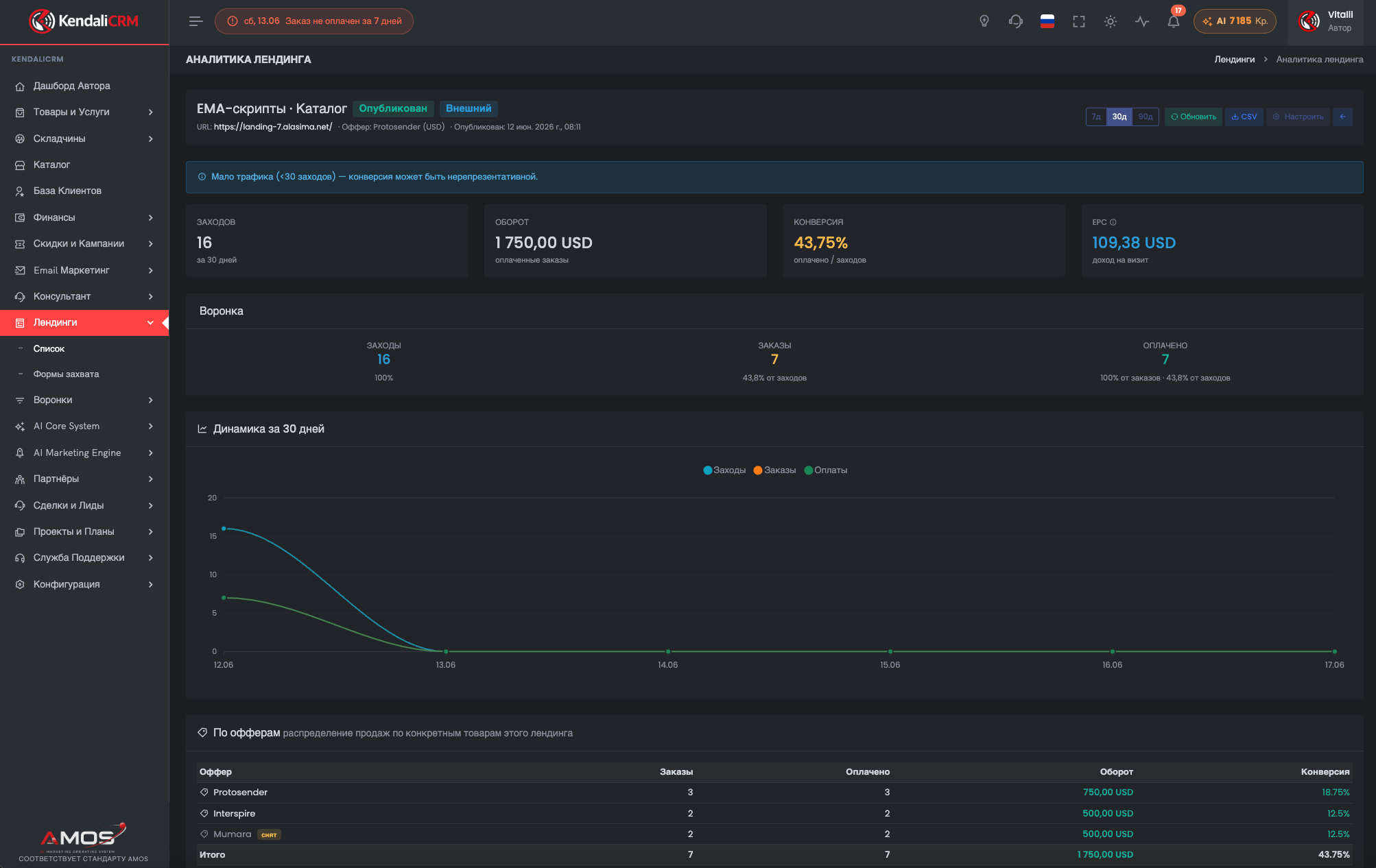
Each landing page gets its own funnel, trend, and offer breakdown
The landing page analytics view shows the key numbers for a period: visits, revenue, conversion, EPC, plus a day-by-day trend and the distribution of sales across offers. This lets you evaluate not just design or traffic, but the commercial performance of the page.
Conversion
The system shows what percentage of visits reached the order and payment. This helps you evaluate the landing page as a selling tool, not just a pretty screen.
EPC / revenue per visit
EPC shows how much money, on average, a single visit brings in. This is exactly the metric that helps you understand which landing page is more profitable to scale through ads or partners.
By offer
In multi-offer scenarios it's especially important to see which product or service sells the page. The offer breakdown helps you quickly rearrange blocks and accents on the landing page.
Not just leads — full unit economics across the funnel
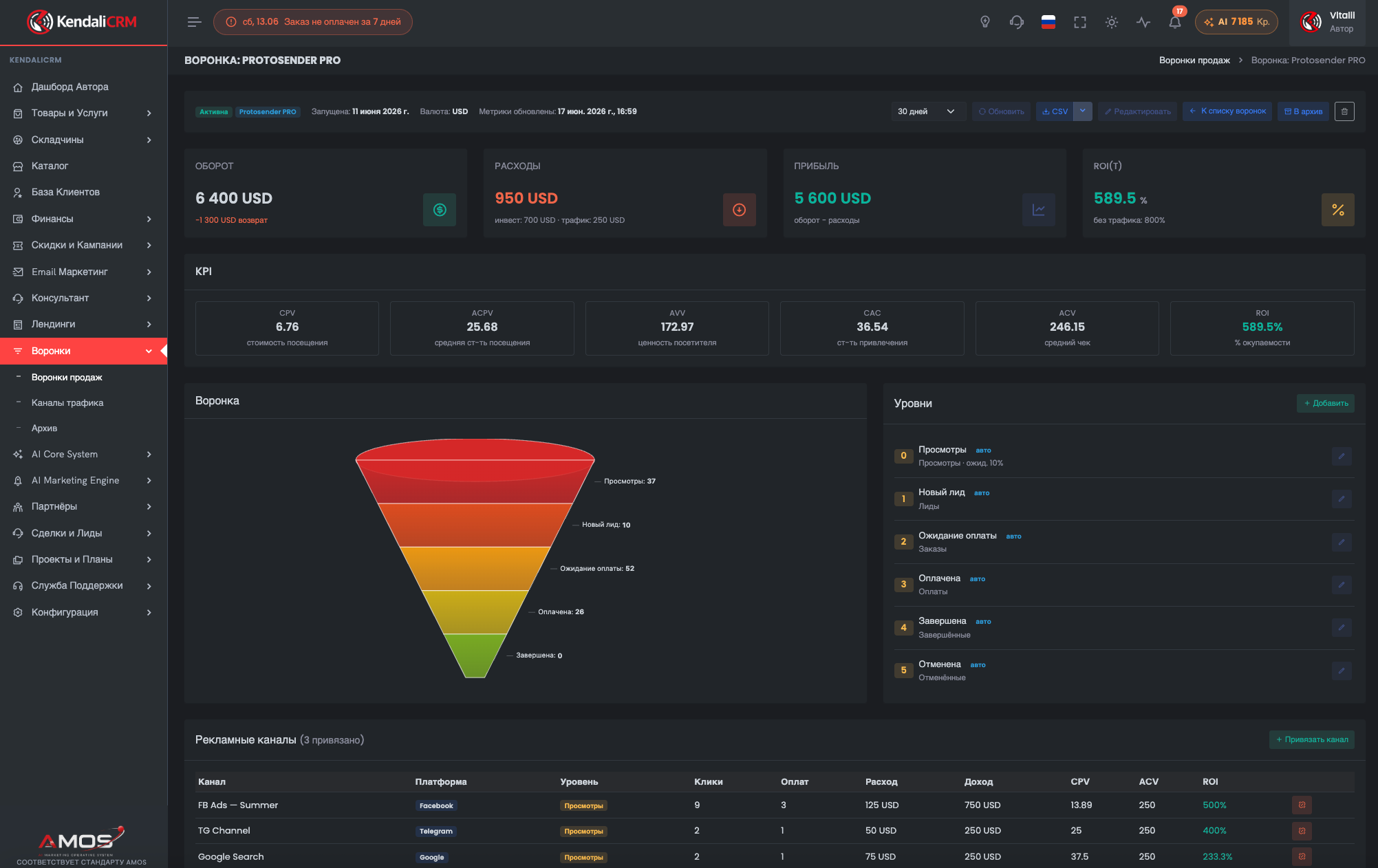
The funnel in KendaliCRM shows not only the stages of the customer journey, but the economics of sales: revenue, refunds, spend, profit, CAC, ACV, AVV, CPV, ROI, and channel payback. Built-in snapshots and a metrics cache let you analyze trends fast without an external BI tool.
Gross / Net revenue
The system accounts for payments and refunds to show the funnel's real revenue, not just the sum of placed orders.
Traffic + investments
You can enter ad spend, design, tools, consulting, and other investments — without them, ROI would be an illusion.
Profit and ROI
The funnel calculates profit as net revenue minus spend, and ROI shows the payback of your marketing efforts and budget.
Bottleneck detection
Conversions between levels help you see at which stage the bulk of people drop off: traffic, leads, pending payment, or closing the deal.
Landing pages and funnels help more than just the marketer
The module delivers the same core benefit to different roles: clarity. Everyone understands where the money is, where the bottleneck is, and what to improve next.
When the landing page, attribution, and funnel live in one system, marketing becomes manageable
You no longer guess which channel pays off, which offer sells the landing page, or where conversion leaks. KendaliCRM gives you a complete picture: traffic, orders, payments, profit, and growth points in one dashboard.