
Scale sales through affiliates without losing control over commissions
KendaliCRM turns your affiliate program from a manual spreadsheet into a managed system: invitations, an offer catalog, referral links, cookie attribution, commissions, holds, USDT payouts, and anti-fraud all run inside a single CRM.
An affiliate program should count money, not just clicks
A typical referral system usually stops at a link and a click counter. In KendaliCRM the affiliate program is built in much deeper: it knows the offer, the landing page, the source, the order, the discount, the refund, the hold, and the payout. That's why the author sees not just "the affiliate brought traffic," but the actual economics: how many clicks, how many payments, what commission, what is frozen, what can be withdrawn, and where there is fraud risk.
Invites, a catalog, and self-enrollment into offers.
Referral links, cookies, and click dedup by IP.
Auto-accrual from the actual price after discount.
Holds, reversals, self-purchase blocking, and anti-fraud.
From invitation to payout — the full lifecycle
The module covers both sides of the process: the author manages affiliates, offers, percentages, holds, and payouts; the affiliate gets a catalog, links, metrics, a balance, and a transaction history.
Invite or catalog
The author invites an affiliate by email with a personal percentage or opens enrollment through the offer catalog.
Referral links
The affiliate gets links to a checkout, a landing page, or a long referral-code format for different promotion scenarios.
Order and commission
On payment, the system records the affiliate, the percentage, the link, and the post-promo price, and creates a commission.
Hold and payout
The commission goes through a protection window against refunds and fraud, then becomes available for USDT withdrawal.
Three types of links for different promotion scenarios
The affiliate doesn't have to build UTMs by hand or negotiate a link format with the author. KendaliCRM creates clear referral routes and mirrors the data into tracking.
Checkout link
Leads straight to the offer's payment page. Great for messengers, email, personal recommendations, and quick sales.
Landing link
Leads to a landing page while preserving affiliate attribution. Great for cold traffic, ads, and warm-up.
Long referral code
Convenient for public materials, reviews, affiliate pages, and long-running evergreen scenarios.
A click becomes a linked source of a sale
- clicks, unique visits, and conversions for every link;
- cookie attribution that takes priority over the URL parameter;
- click deduplication by IP within a time window;
- recording the affiliate, the percentage, and the link in the order;
- protection against self-attribution and self-purchases;
- separate tracking channels for the affiliate's different sources.
Affiliate click
  → referral token
  → cookie attribution
  → landing / checkout
  → order created
  → payment confirmed
  → commission on hold
  → balance ready for payout
Commission is calculated automatically, but the money is protected until the risk is over
The affiliate gets rewarded only on real payments. If a promo code is applied, the commission is calculated from the reduced price, and on a refund the system performs a full or proportional reversal.
Percentage of the real price
The commission is tied to the actual order price after discount. This protects the author from overpaying commission on promo campaigns and special offers.
Hold for the refund window
For regular products the commission goes on hold for the refund window. For group buys the logic runs longer: a prepayment may wait for completion and then get an additional protection window.
Reversal on refund
If an order is canceled or partially refunded, the commission is rolled back proportionally. This keeps the economics fair between the author and the affiliate.
Accrual
On a confirmed payment, a commission is created from the actual price after discount, and the affiliate, percentage, and link are recorded.
Hold
The commission isn't available for withdrawal right away: it's frozen for the refund window so the author doesn't lose money on cancellations.
Why it matters
Without holds, someone could bring in a disputed order, withdraw the commission fast, and then get a refund. The payout cycle shows the affiliate their future income while protecting the author.
The affiliate program is built into offer cards, group buys, and analytics
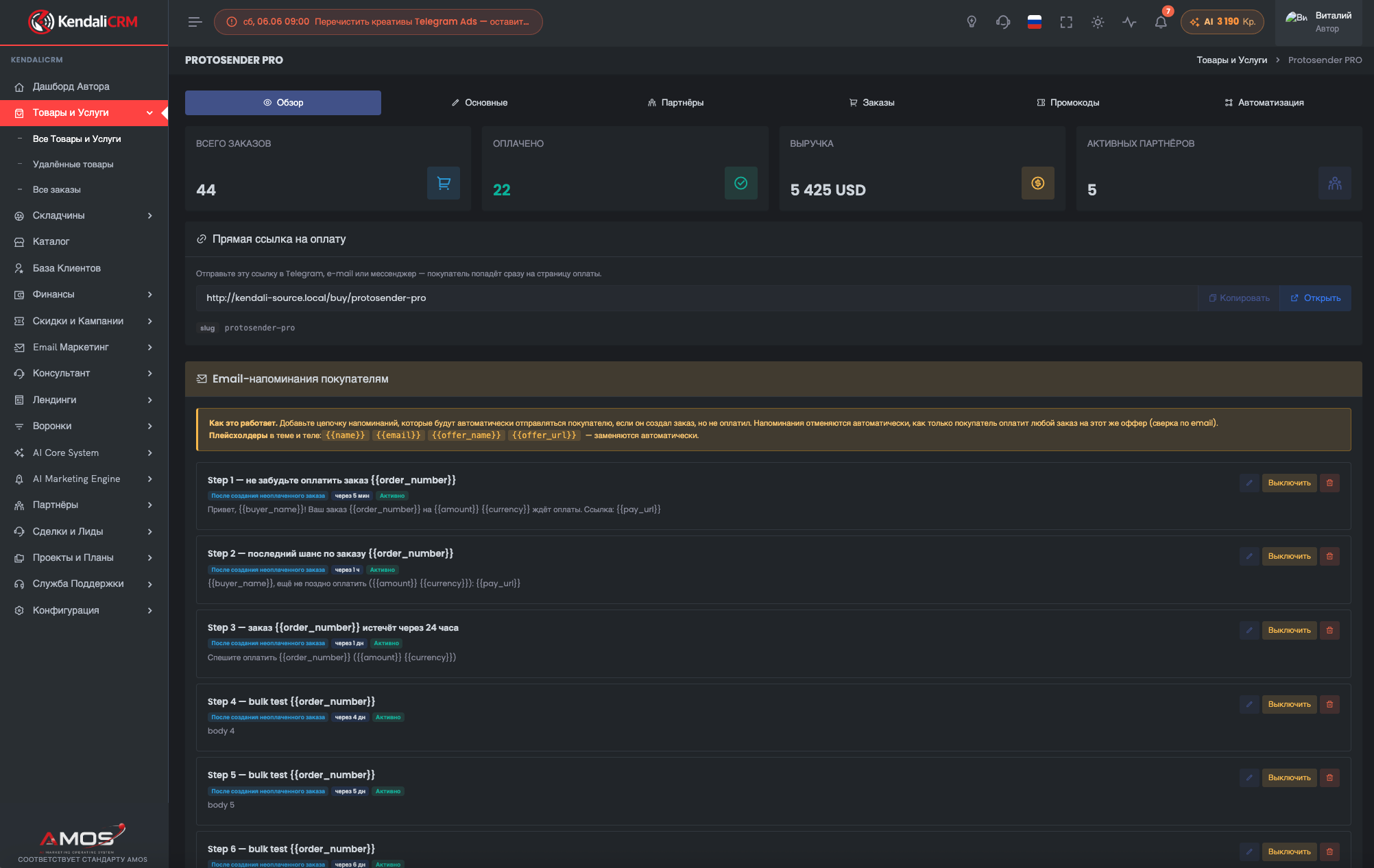
In the KendaliCRM cabinet, the affiliate program doesn't exist apart from sales. At the offer level you see active affiliates, the group buy has a dedicated affiliates section, and in marketing reports the affiliate channel takes part in the overall economics.
Group sales also plug into the affiliate program
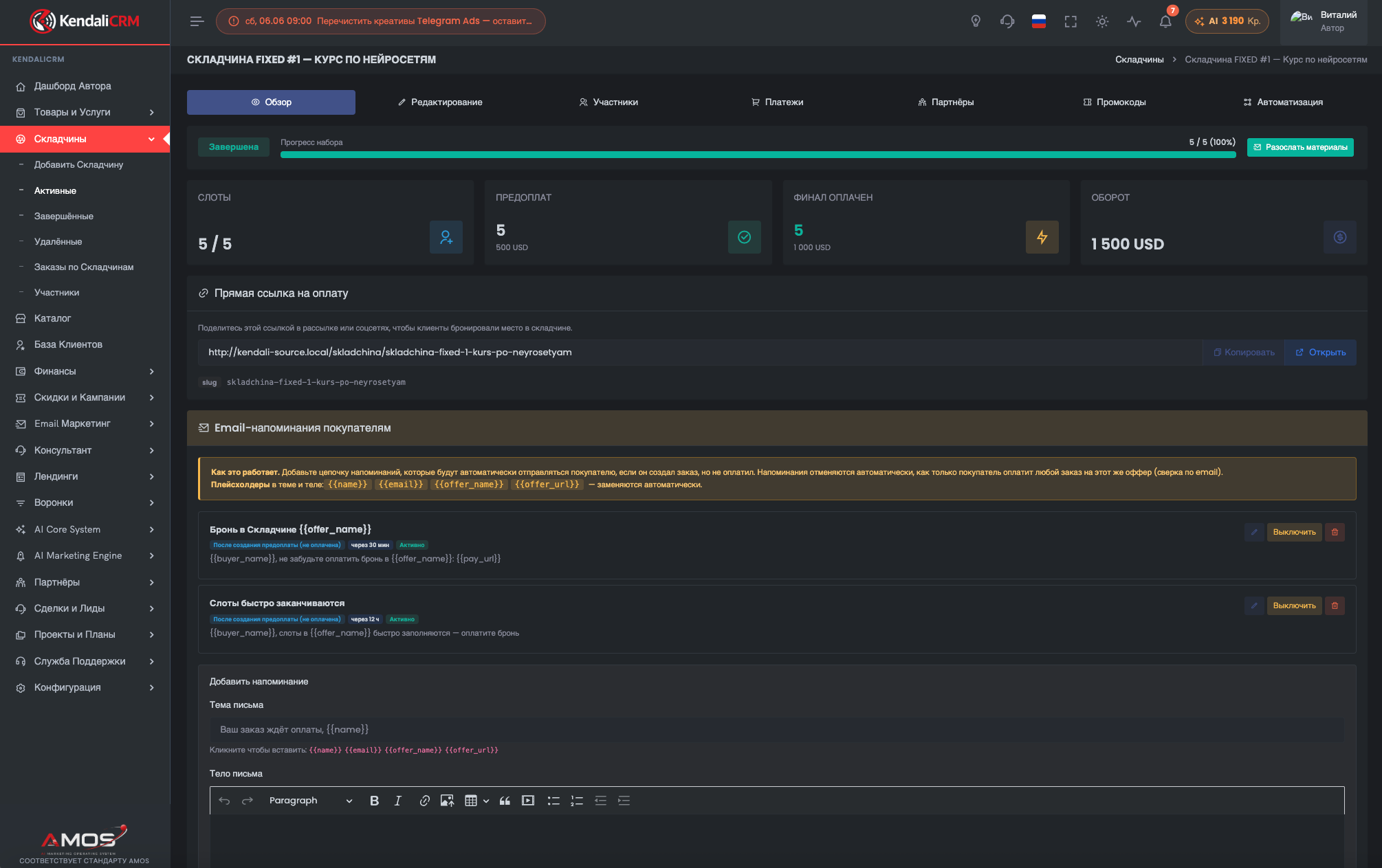
A group buy is its own group-purchase mechanic, and the affiliate section is built into it right next to participants, payments, promo codes, and automation. The affiliate gets their own links to the group buy, and the commission accounts for the prepayment and final-payment phases.
Layers of protection against fake activity, self-purchases, and disputed commissions
The main job of an affiliate program is to scale sales, not to open a hole in your finances. That's why KendaliCRM checks not just the fact of a visit, but the link's right to a conversion, refunds, self-purchases, operation races, and suspicious patterns.
Right to a conversion
Conversions count only for active and allowed links, not for any old token.
Rollback on refund
If an order is refunded, the conversion and commission are adjusted so reports don't overstate the result.
Self-purchase blocking
The system normalizes email and phone so an affiliate can't credit a commission to themselves.
Race-safe operations
Simultaneous actions don't create double accruals, double conversions, or conflicting statuses.
An extra hold on suspicious conversions
- a cold affiliate with few clicks and a fast purchase;
- a suspicious pattern gets an extended hold window;
- fraud signals and self-purchase attempts are visible to the author;
- a questionable commission doesn't move to payout prematurely.
Conversion
  → link eligibility check
  → email / phone normalization
  → self-purchase check
  → base hold
  → extra hold on suspicion
  → reversal on refund
USDT withdrawals with a clear status and balance protection
The affiliate can add a wallet, choose a network, and create a request. The author sees pending requests and can approve, reject, or mark a payout as paid with the transaction hash.
Wallet
The affiliate adds a TRC-20 or ERC-20 USDT wallet and chooses a default wallet.
Request
Creates a request for an amount above the minimum threshold with a comment.
Approval
The author checks the available balance and moves the request to approved.
Payout
After the transfer, the transaction hash is entered, the request gets the "paid" status, and the balance is recalculated.
The author sees not just the balance, but the quality of the affiliate
- clicks, orders, turnover, profit, and total commission;
- LTV, AOV, conversion, refund rate, and trust badge;
- fraud signals, self-purchase attempts, and author notes;
- the affiliate's links by products and group buys;
- blocking or unblocking links;
- CSV export and filters by key attributes.
pending
  → approved
  → paid + transaction hash

pending
  → rejected / canceled

approved
  → amount returned to balance
The affiliate channel is visible right next to ads, direct sales, and landing pages
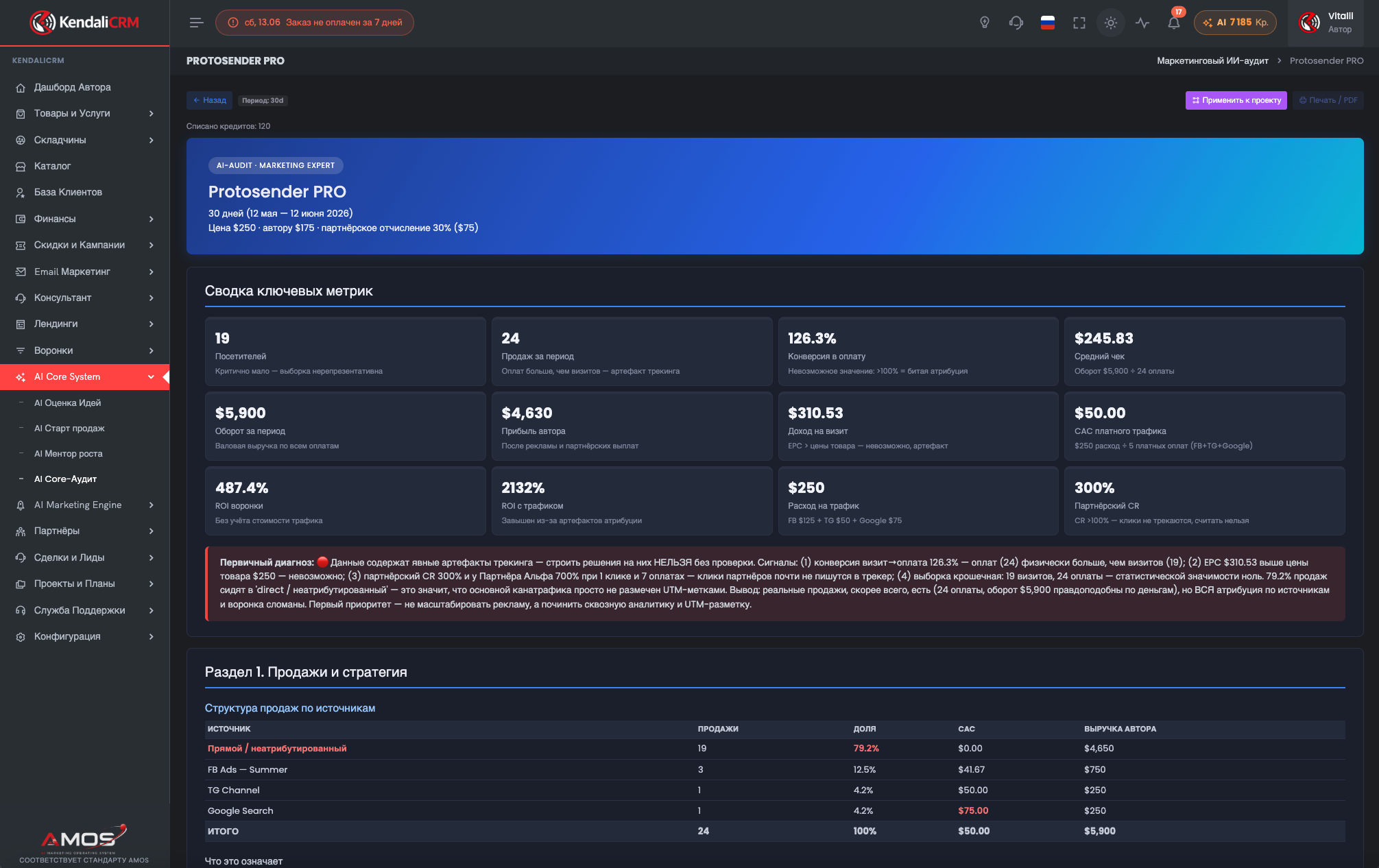
Because the affiliate program runs on the same data model, it takes part in the overall picture of the business: orders, sources, channels, revenue, ROI, conversion, and AI audits can all account for affiliate sales as part of the marketing system.
The KendaliCRM affiliate program is built for those who sell through trust and traffic
The module suits authors of digital products, the info-business space, software sellers, agencies, online schools, and anyone who wants to build a referral network without manual bookkeeping.
An affiliate program becomes a safe growth channel when it's tied to the CRM, payments, and finances
KendaliCRM gives the author control over the entire chain: from the affiliate's first click to the final payout. It's not a standalone referral script, but a part of the AMOS marketing operating system.