
Launch digital products, services, and group sales in one system
KendaliCRM turns your offer catalog into a full-fledged sales hub: products, digital delivery, group buys, manual USDT invoices, promo codes, partner commissions, orders, CRM, and finance all work as one connected mechanism.
This is more than a product list
KendaliCRM builds an operating system around every offer: a public link, checkout, a payment scenario, delivery, follow-up, affiliate program, refunds, a financial ledger, and channel analytics. The author doesn't have to stitch it all together by hand from a store, a form, an email tool, a spreadsheet, and a CRM.
The offer gets a slug, a payment page, and an auto-funnel.
Payment goes through the available scenarios, including USDT.
After payment, the client receives the material or next-step instructions.
The order, contact, deal, revenue, and commission are recorded automatically.
An offer card that's ready to sell from day one
In KendaliCRM, a product isn't a static catalog entry. It's a connected sales object with a price, currency, delivery, partner share, discounts, publication statuses, and its own analytics.
Products and digital goods
Courses, templates, scripts, checklists, access passes, recordings, PDFs, software, or any digital materials. For each offer you set a name, description, base price, currency, and visibility.
Digital delivery
After payment, the client receives a link to a file, a dashboard, instructions, or gated content. The delivery text can be personalized with placeholders for the name, order, and access link.
Discounts and partner share
The offer works with promo codes, exit-intent discounts, auto-promo links, and the affiliate program. Commission is calculated on the real price after the discount.
Everything you need for a commercial launch
- price, currency, and a compare-at price for the discount effect;
- visibility, availability for sale, and admin lockout;
- digital delivery link and post-payment text;
- default partner share from 0 to 90%;
- automatic funnel built from sales levels;
- analytics for orders, payments, revenue, and sources.
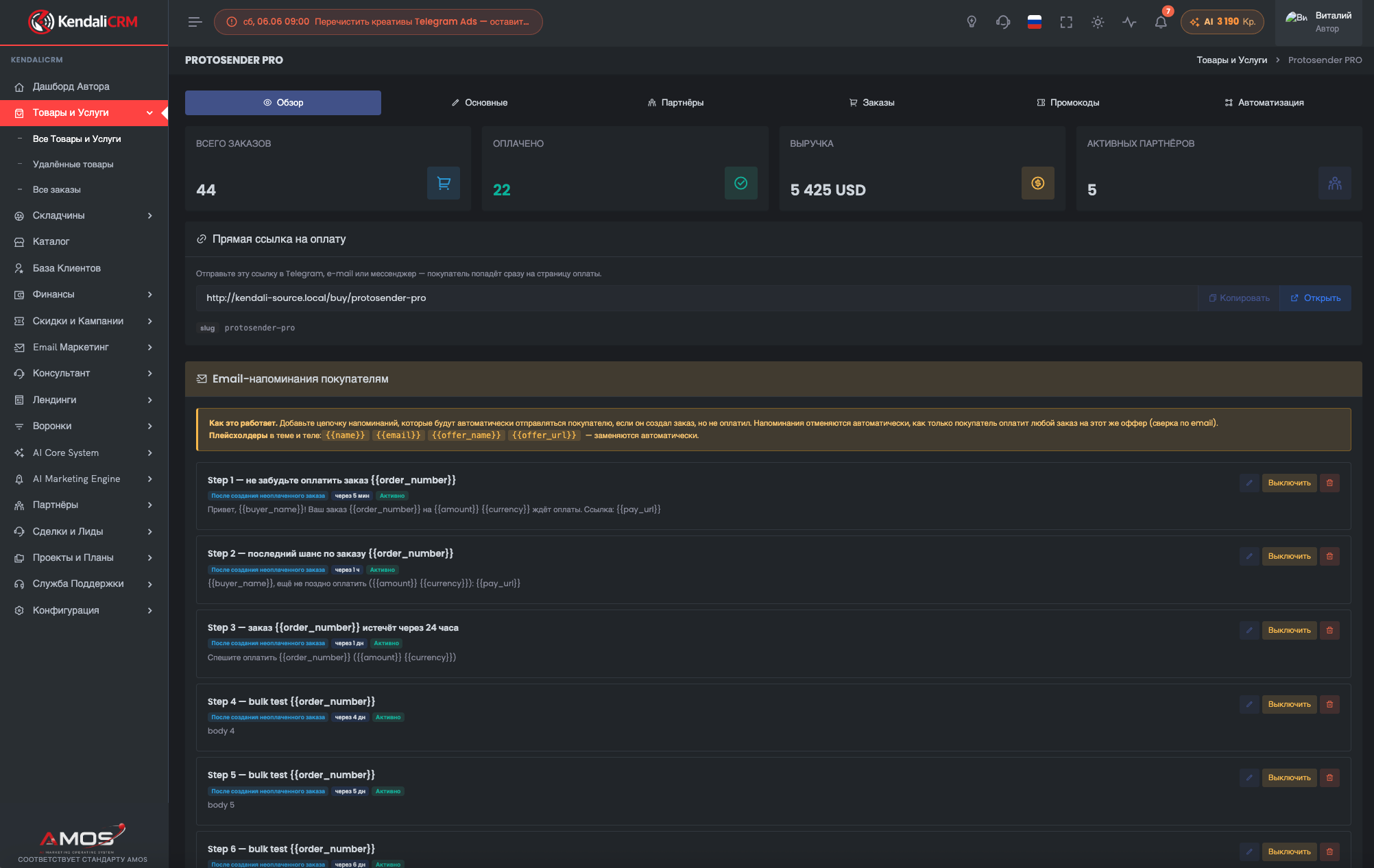
/buy/protosender-pro
  → checkout
  → awaiting payment
  → payment confirmation
  → material delivery
  → Contact + Deal + Finance Ledger
The author sees sales in the context of the offer, not in isolation
The product page brings together KPIs, the payment link, orders, partners, promo codes, and automatic email reminders. This lets you manage sales without switching between a dozen services.
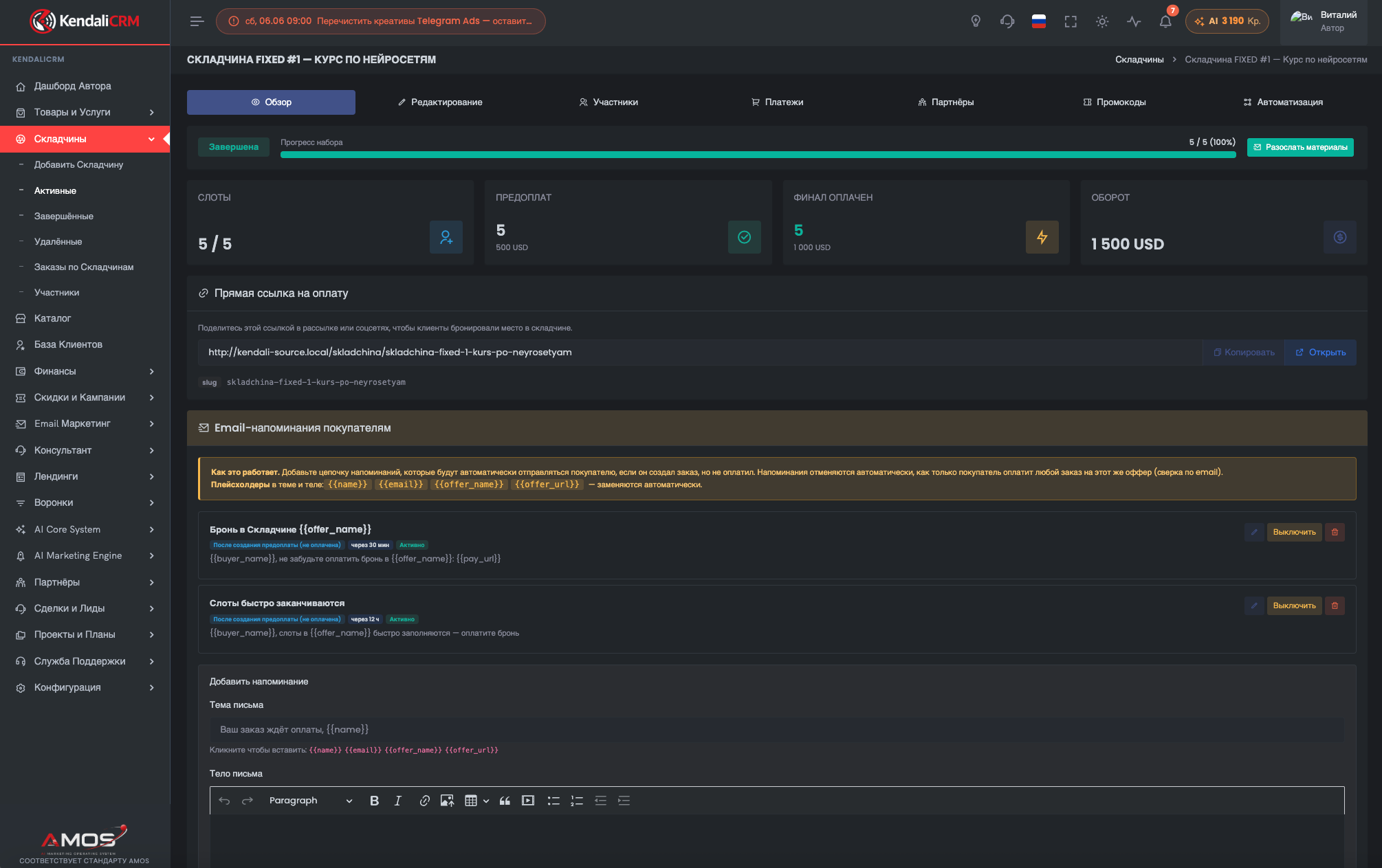
Group buys: mechanics a CRM usually doesn't have
A group buy helps you sell high-ticket products through collective purchasing: participants reserve a spot with a deposit, then pay the final portion, while the system controls phases, deadlines, emails, refunds, and material delivery.
Collecting deposits
The participant submits an email, name, and phone, gets a deposit order and an email. Duplicates and over-limit signups are blocked.
Moving to the final stage
In the FIXED model, the final stage triggers when spots fill up; in SPLIT, the amount is recalculated based on the actual number of payers.
Final payment
Participants receive the amount and a deadline. The author can credit the final payment manually or share a public token-based link.
Completion and delivery
Once fully paid, the system marks the group buy as completed, opens the refund window, and sends the material.
FIXED
A fixed model with a target number of participants, a deposit, and a final price known in advance. A fit for courses, software, templates, and gated access.
SPLIT
A flexible model where the total budget is split across the number of payers. Handy for jointly buying a high-ticket product or access.
Automation
Deadlines, reminders, holds, refunds, and repeat rounds are built into the process, not tracked by hand in a spreadsheet.
Manual invoices cover everything that doesn't fit the catalog
A consultation, setup, audit, custom work, an add-on payment, an individual package — all of it can be sold without creating a separate product. The author issues an invoice for the needed amount, and the client pays it through the same payment cycle.
A manual invoice is a fast checkout without a product
An invoice is created from the client's email and name, and includes the amount, currency, description, and a business payment deadline. After payment, the system runs the same full cycle: order, contact, deal, and a financial record.
- fits services, consultations, and individual offers;
- requires no partner commission or separate product card;
- shows overdue status based on the business payment deadline;
- works through the same USDT payment page with QR and TTL.
Every sale moves the whole system
In a typical stack, a sale often ends with a payment notification. In KendaliCRM, it triggers a chain of events: it updates the order, creates a contact, moves the deal, posts to finance, checks the partner, cancels follow-up, and saves the history.
Order statuses
Pending, paid, canceled, refunded, and partially refunded run through a state machine with clear side effects.
Contact and deal
The buyer lands in the client base, and the deal moves through stages with no manual entry.
Revenue and holds
The sale, refund, partner commission, and available funds are recorded in the financial ledger.
Emails and reminders
Access is sent after payment, and unpaid orders can be nudged with follow-up sequences.
One module covers different monetization models
It's not just for course authors. The same offer engine works for a digital creator, a consultant, an online school, a script developer, a software owner, and a seller of expert services.
A sale in KendaliCRM isn't a pay button — it's a managed business process
You create an offer once, and from there the system connects a payment page, delivery, CRM, funnel, affiliate program, finance, refunds, and analytics around it. That's the AMOS approach: not scattered tools, but a single operating environment for growth.